
Are you Local or Organic?
This is a conversation or question if you will that doesn’t seem to be going away and honestly it shouldn’t. However, it seems that with the re-opening of the various farmers markets across the country and peak growing season underway individuals are once again thinking more about what’s best for themselves and families food wise. 
Trying to decide between the local farmer who uses the occasional herbicide or organic from the Supermarket that traveled over 300 miles. Some experts have weighed in, urban areas across the country are challenging residents to eat local, Food

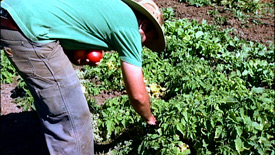
Bloggers are flexing their culinary muscles featuring dishes utilizing local goodies and so I have decided to put my two cents out there as well and I prefer local. One thing to remember which I think new local converts forget is that local doesn’t necessarily mean that it’s organic. Personally I prefer local because I feel strongly about supporting local businesses whether it be a farmer, jewelry maker, etc. There is such a strong sense of community that I get from supporting my local folks. One bonus about being a locavore is more often than not when you speak to farmers at the local market you’ll find out that they do utilize organic and sustainable farming methods but they have never gone through the very expensive and time consuming process to become USDA certified organic.
And as for buying organic versus local for me it all depends on the individual food time.
Writer Jeff Cox has written a terrific little guide that I refer to often, “The Organic Food Shoppers Guide”, in this purse size guide the author tells you exactly what foods you should be buying organic and those you can pick up at markets and food stores without guilt. Organic Strawberries, yes but Blueberries, no. Bottom line no matter what you decide be it local or Organic always remember that if you eat seasonably you can’t go wrong in terms of great food flavor. There’s nothing worse than a hothouse tomato in January.
Next Time: Victory is mine, Tales from the Vegetable Patch.

Heather Jones is a wife, mother, freelance food writer, and graduate of the Institute of Culinary Education in New York City. She has worked for Gourmet Magazine, TV Personality Katie Brown, and the New York based Indian-fusion restaurant Tabla. Heather resides in New Jersey with her husband and two daughters. She is a strong supporter of the Sustainable Food Movement and believes that education is the key to making a difference.
Tags: blueberries, conventionally grown food, fresh, local food, organic, seasonal, Sustainable Living, tomatoes, wholesome


Share
Digg
Bookmark
Stumble
Miro
3 Comments
we are lucky to have three local and organic farmers we buy from.
and organic strawberries in peak season here, is like heaven on earth!
i find it impossible to be 100% organic anyway, so like you said, i weigh the options of most heavily polluted foods and get whatever i can here locally.
We don’t go out of our way looking for tomatoes in January (in the District of Columbia), but we’ve had some off-season, hot house tomatoes that were pretty darned good. Someone is getting better at breeding and raising them. And does local mean only “seasonal?” What if the hot house tomatoes are being grown in your neighborhood and are really good? And in temperate areas where the normal growing season ends in September or October, if everyone goes local won’t they necessarily need to grow things in hothouses?
Thank you for this thoughful article. The Organic Trade Association would like to offer a different perspective on the issue of local vs. organic. In fact, local and organic are not in competition with one another. On the contrary, they embrace many of the same values. They both emphasize support for the farmers involved in food production. And they both encourage people to consider the environmental impacts of their purchasing decisions. Plus, as more and more local farms make the shift to organic, the choice between local and organic disappears: to buy one is to support and reap the benefits of both.
What should you do, then, if you are in the grocery store and the option to purchase locally grown, organic products does not exist? Which type of product should you choose?
When faced with such a choice, consider the following: organic offers a range of benefits that non-organic local products do not. Because they are regulated by the federal government, products bearing the organic label must meet a strict set of production/handling guidelines. They must be made without the use of toxic and persistent pesticides, hormones, antibiotics, and genetic engineering. Additionally, they must not undergo irradiation or contain ingredients made from cloned animals. Local products are not held to any such standards, and therefore cannot be counted on to meet any of the aforementioned criteria. And, because the term “local” is itself undefined, no guarantees can be made about whether a product is, indeed, local!
Organic products are also distinct with respect to traceability. In order to meet federal regulations, careful records must be kept about every phase of organic production. This means that everything from the source of the seeds to the way the products are placed on store shelves must be documented. Moreover, each of these steps must be verifiable by a third party. Local products, by contrast, are neither required to provide such documentation nor to undergo third-party review. As such, no guarantees can be made about where local products come from or how they are handled.
Does this mean you should abandon buying locally made products? Not at all. Instead, it means you should be thoughtful about the local products you choose to buy. If they are labeled organic, you can feel confident that they have been produced in a manner that not only supports personal and environmental health, but also helps to ensure product integrity from the farm to your family.