Cooking Up A Story


Community Egg Co-op

Friday, February 29th, 2008
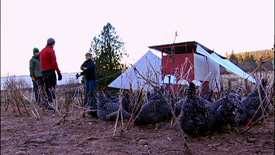
This is a story about a community egg cooperative formed by a group of volunteers, bringing chickens to a working urban farm, and managing the production of eggs for themselves and a local CSA.
Download Show: MP4 | WMV | iPhone

Recipes from the episode: Garden Greens Quiche; Barley Eggs

Director’s Journal

Don’t miss the complementary story (below the journal) published by our friends at Edible Portland Magazine: Eastside Egg Co-operative

I’ve been wanting to do a story on eggs for quite awhile, so when Deborah Kane, of Ecotrust Food & Farms, told me about the Eastside Egg project, I almost became giddy. Yay! Chickens and eggs!

  • A Hen At The Urban Farm
  • Hens Feeding and Being Given Drinking Water
  • Close Up Of Eggs
  • Chickens Under The Awning

It’s very cool how serendipity played into this coming together. Patrick and Holly, previous chicken owners themselves, belong to a local CSA which had recently lost its egg supplier. Patrick suggested the idea of a cooperative to Laura Masterson who knew of a local urban farm which had a Heifer International grant for small livestock. And voilá, the Eastside Egg Cooperative of Zenger Farm was hatched, er, born.


There are so many benefits to raising chickens. They are a great addition to any garden, they clear out whatever area of land defines their boundary, and they also leave their nitrogen rich manure for the next round of plantings. The eggs from these naturally raised chickens are higher in the good omega-3 fatty acids than eggs produced from factory farms, not to mention being fresher. Typically, eggs from the supermarket are at least 2 weeks old before they even reach the shelf.


Craig Clark, another co-op member and one who also raises his own chickens at home, said taking care of chickens run somewhere between a cat and a dog. If you have the right set up, and as long as they have access to quality food and fresh water, he says they can be left for up to 3 days. Please note: this is only on occasion, if you have to leave home for a few days.


I recently discovered a website put together by another filmmaker, Patti Moreno, whose passion is living in a sustainable way. She shares her knowledge of gardening, cooking, crafting, and more, on her website GardenGirlTV. The one that tied in beautifully with “Community Egg Co-op” is her upcoming 6 part series “How to Build a Chicken Tractor”. If you’re interested in building a coop for a raised bed, check out Patti’s video here, and check out her website too!


If this is something you think you’d like to try, find out if chickens are allowed where you live, and if yes, like Patrick says, make it happen!


—Rebecca


EASTSIDE EGG CO-OPERATIVE
Fifty Chickens and a Grand Idea
By Angela Sanders
For Spring 2008


Eastside Egg Co-operative member and two Barred Rock hens.
Photo by John Valls


Edible Portland Magazine: Spring 2008 Issue

Early on a November morning when it was still dark, fourteen members of the Eastside Egg Co-operative braved the driving rain to gather at Zenger Farm. They had come to move a chicken coop.

The coop movers, the smarter of them wearing rubber boots, walked past a field of leeks to a coop smaller than an upended outhouse. The 50 hens shut in the coop started to cluck as they heard people approach. As the coop was lifted, the hens’ cackling jumped to a fevered pitch. Once the coop was set down in its new home in an adjoining field and the coop’s door opened, the hens shot out like cannonballs, quickly scattering to peck at chickweed. A glance back showed the chickens’ old field pecked clean down to the dirt.

The Eastside Egg Co-operative is a group of Portlanders who take care of a flock of Barred Rock hens in exchange for eggs. Zenger Farm, a nonprofit educational farm in east Portland, provides supplies, land for the hens and coop, and room in the barn to store eggs and supplies. In return, Zenger Farm receives free fertilizer for its fields and an educational opportunity for visiting school children.

Patrick Barber and Holly McGuire run the co-op. They manage volunteers and work with Laura Masterson, who farms at Zenger, to coordinate where to move the chickens so that they forage from finished crops and fertilize fallow fields in preparation for the next crop.


The chicken coop on Zenger Farm and the bounty shared
by Eastside Egg Co-operative members. Photos by John Valls


Last April, Barber idly mentioned to Masterson that it might be interesting to start an egg co-operative. Instead of selling eggs as a business, a group of people could tend the chickens together, sharing labor but also sharing eggs. He and McGuire had worked for a car co-op in Oakland and liked the idea of co-operative agriculture.

As it happened, Masterson had thought about keeping chickens at Zenger Farm. She had drawn up a crop and chicken coop rotation schedule and even bought an electric fence to keep chickens in and predators out. Right away she offered to put Barber in touch with a farmer who was getting rid of his hens.

Helping to move the process along, Zenger Farm had just received a two-year grant from Heifer International to raise livestock, including chickens, worms, and bees. If Barber and McGuire could find enough volunteers for two daily shifts of chicken duty, the grant would pay for chicken feed, bedding, and building materials for the coop. It would be, as McGuire said, “a thought experiment come to life.”

Barber and McGuire put out the word for volunteers. They hung notices at cafés around town and posted on a listserv. In the end, almost twice as many people applied for the co-op as there were shifts available. “We didn’t even think we’d get enough volunteers to cover all the shifts,” Barber said.

The Eastside Egg Co-op’s members draw from a wide swath of Portlanders. One member is a school teacher, another is a firefighter, and yet another is a “polysomnographic technologist” (someone who measures sleep patterns) at Oregon Health & Science University. One member looks forward to bringing her grandchildren to feed the chickens, and another member plans to track the yield of eggs by the phases of the moon.

The co-op’s first task was to build a chicken coop that could be moved between fields. It turned out that many of the members of the co-op had definite opinions about what sort of coop should be built, and soon ideas floated for a five-star hen paradise on wheels. Sacha White, the owner of Vanilla Bicycles, a custom bicycle frame builder, agreed to make armatures for the coop’s wheels. After friendly discussion and White’s practical suggestions, the coop’s original grand design became a simple 4′ x 4′ x 8′ coop with nesting boxes that open to the outside. By the summer solstice, the coop was up and the hens were in residence.

Since then, the egg co-operative has had a few minor setbacks: One hen died of natural causes, the barn door froze shut, the coop blew over in a windstorm, and the coop’s wheels still haven’t been mounted. Perhaps the most visible problem has been that a handful of hens peck at lower status hens to the point that they’ve yanked out all their tail feathers and drawn blood. In a large chicken operation, chicks are often de-beaked to prevent this problem. The co-op’s consensus was that 50 beakless chickens roaming the field might put visiting children off agriculture for good. Other options deemed impractical were purchasing headgear for each hen to prevent her from seeing hens nearby, and painting each hen’s hind end daily with a sour liquid. Finally, the co-op gave away the five meanest hens.

For the most part, the co-op has run smoothly. Co-op members have faithfully made their shifts, unlatching the coop’s door as the sun rises or watching the chickens go to roost as the sun sets. The hens have steadily laid eggs with latte-colored shells and firm orange yolks.

The next step will be to determine how to make the co-op financially self-sustaining. Since hens lay fewer eggs as they age, the co-op will need to give away some hens and buy or hatch chicks. (At one co-op meeting members briefly discussed getting a noise variance to bring in a gigolo rooster.) The co-op may also start to charge a low monthly fee to its members or offer chicken husbandry classes.

Ultimately, Barber and McGuire would like to see egg cooperatives spread throughout the city. Families could save money and labor by linking backyards and sharing chickens. As McGuire said, “People need to work together. We’re stronger and we get more done collectively.”

Angela Sanders writes about Pacific Northwest history and culture. For more stories, please visit Edible Portland Magazine.

Additional Resources


Subscribe Subscribe To Us By RSS

Subscribe Subscribe By Email

5 Responses to “Community Egg Co-op”

  1. Seacoast Eat Local » Blog Archive » Community egg co-op Says:

    […] A CSA in the Pacific Northwest worked with their farmer to make eggs happen for the group. It’s great to see some really creative solutions and I love the idea of cooperating to take care of animals. From Cooking Up A Story > […]

  2. Moni Says:

    Rebecca, I absolutely just loved this!

  3. rebecca Says:

    Thanks, Moni! I’m with you, I love what these folks are doing. And the fact that this idea could be started in many other communities. Very beneficial to many…to the volunteers, to the farmer/grower, and to the CSA.

  4. Moni Says:

    Rebecca, you can tell by their energy and their expressions it’s a very good deal indeed! Wins in all directions, I agree with you totally. Wow, just loved it!

  5. Portlanders: Are you looking for an egg co-op? « Locafour Says:

    […] Or check out this video about them by Cooking Up A Story. […]

Leave a Reply