
This ocean series is dedicated to the celebration and reflection of World’s Ocean Day, on Monday, June 8, 2009.
It would not be hard to imagine the impact on the land’s ecosystems, if humans mostly hunted wolves, and other predators for food at the top of the food chain. As Alison Barratt, from the Monterey Bay Aquarium Seafood Watch program informs us, that is precisely what we do when we fish for tuna, salmon and other top predators of the sea. Artificially disrupting the mix of predator to prey (in this case, through industrial fishing practices on a massive, global scale), damages the built-in mechanisms that keep animal populations in proper balance, and harms natural ecosystems that support life.
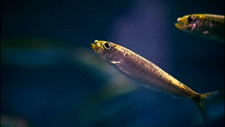
Here is a partial list of sustainable fish choices that are environmentally friendly to harvest, abundant, and well managed from the Seafood Watch Pocket Guides:
All Regions
Some Best Choices
- Arctic Char (farmed)
- Catfish (U.S. farmed)
- Crab, Dungeness
- Halibut, Pacific
- Mackerel, King
- Mackerel, Spanish
- Mahi Mahi / Dolphinfish (U.S. Atlantic troll/pole)
- Sardine (U.S. Pacific)
- Shrimp, Pink (Oregon)
- Whitefish, Lake (Lake Superior, Lake Huron, Lake Michigan trap-net)
Some Good Alternatives
- Basa (Imported farmed)
- Black Sea Bass
- Dogfish, Spiny (British Columbia)
- Halibut, California (hook-and-line or bottom trawl)
- Halibut, Greenland
- Herring, Atlantic
- Herring, Lake
- Lobster, American/Maine
- Salmon (Washington wild-caught)
- Smelt, Rainbow (Lake Superior, Lake Michigan, Lake Erie)
Some Seafood to Avoid: Overfished, and/or fished or farmed in ways that hurt other marine life, or harm the environment.
- Chilean Seabass
- Cod, Atlantic
- Crab, King (Imported)
- Flounder (Atlantic)
- Halibut, Atlantic
- Halibut, California (set gillnet)
- Rockfish (trawl-caught)
- Salmon (farmed)
- Swordfish (Imported)
- Shrimp (Imported farmed)
- Shrimp (Imported wild-caught)
Check out these related videos from this series: State of the Oceans Health: In Crisis (Part 1) Alison Barratt, from the Monterey Bay Aquarium’s Seafood Watch program discusses the health of the oceans in relation to native fish populations, and the decline of their ecosystems. Sardines: Sustainable Food to Feed the World Dr. Geoff Shester, the Senior Science Manager, Monterey Bay Aquarium’s Sustainable Seafood Initiative describes a sustainably managed fish, high in protein and healthy nutrients, abundant, inexpensive to produce, that could feed a large number of people, affordably. So, what’s the problem?
Most of the videos featured on Cooking Up a Story were produced, filmed, and edited by Rebecca Gerendasy. Fred Gerendasy contributed as a writer to many of the posts and occasionally as the interviewer. Visit Rebecca Gerendasy Clay – Art and Fred Gerendasy Photography to see their current work.